Representation Review 2024
The way our district is structured is changing
What is a Representation Review?
All local councils must carry out a representation review at least every six years. This is to ensure residents have fair and effective representation at local elections. A representation review looks at things such as changes in our population, the number of elected members needed to fairly represent our communities, the existence of wards and community boards, and where the ward boundaries are.
In Waikirikiri Selwyn, we do representation reviews more often than the minimum amount. This is because our population is growing quickly, and some parts of our district are growing more than others. In fact, since our last review in 2021, our population has grown by around 13% and we now have an uneven number of people that each councillor represents. Doing more regular reviews serves our community better, and aligns with two key principles mandated by the Local Electoral Act 2001 Act:
- The ‘effective representation of communities of interest’
- ‘Fair representation of electors’
We’re undertaking a representation review on how our community is represented in Waikirikiri Selwyn. This means we’re reviewing ward boundaries, the number of wards, and how many councillors represent a ward.
How are we currently represented?
Following the most recent election in 2022, the Selwyn District Council is currently made up of:
1 mayor – elected at large
10 councillors – elected from four wards:
- Ellesmere (2 councillors, includes Dunsandel, Doyleston, Leeston, and Southbridge)
- Malvern (2 councillors, includes Hororata, Coalgate, Glentunnel, Darfield, Kirwee, Sheffield, and Springfield)
- Rolleston (3 councillors, includes Rolleston, West Melton and Burnham)
- Springs (3 councillors, includes Prebbleton, Lincoln, Tai Tapu, and Springston)
1 community board - for the Malvern Ward, with five members elected from three subdivisions:
- Hawkins subdivision (2 members)
- Tawera subdivision (1 member)
- West Melton subdivision (2 members)
Final determination April 2025
We have now received the final local government commission (LGC) determination for our representation review.
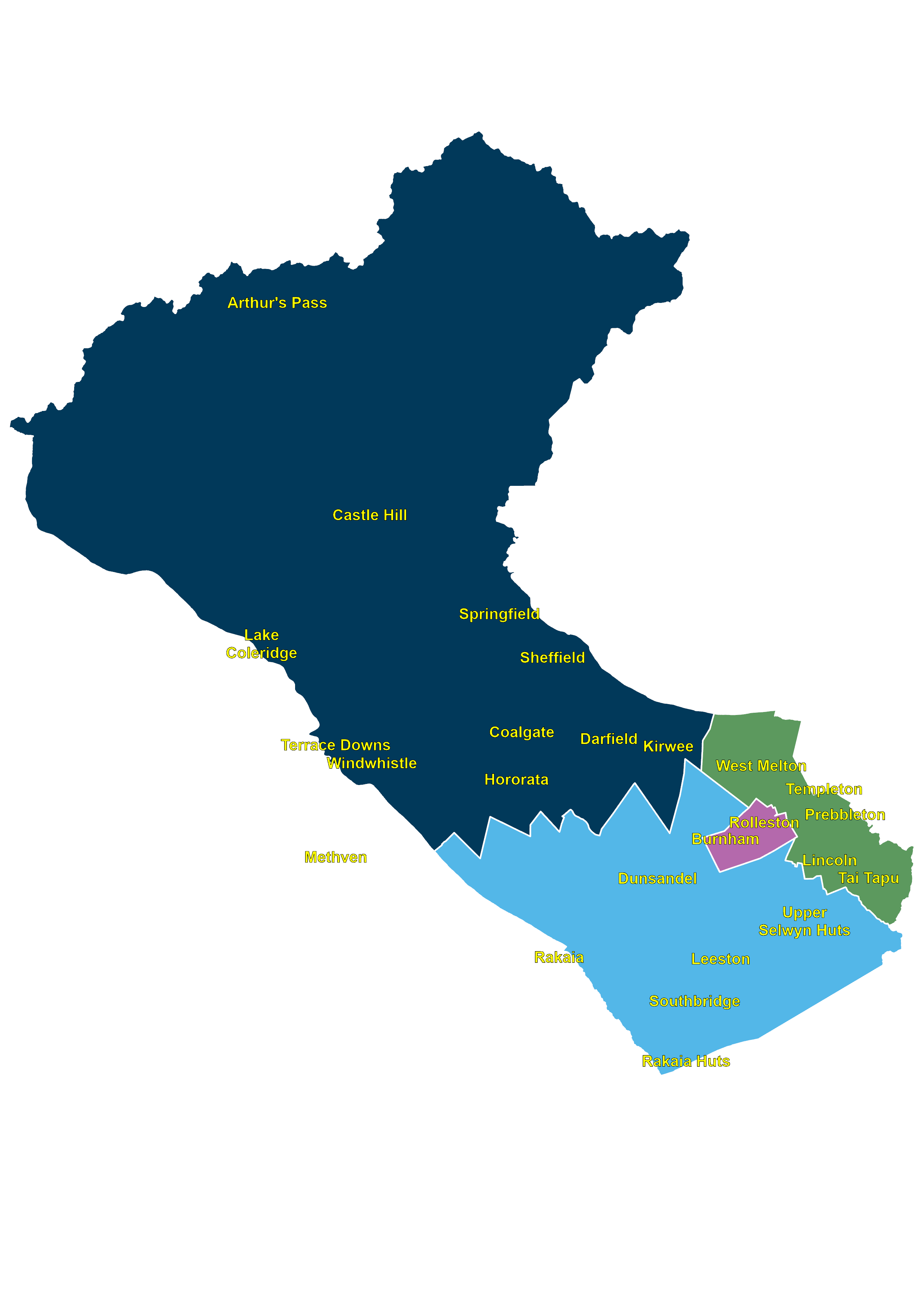
Their determination included maintaining the ward boundaries of the initial proposal, with the most notable changes being moving Burnham into the Kā Mānia Rolleston Ward, and West Melton into the Kā Puna Springs Ward.
The Council will consist of a mayor and ten councillors, with two councillors elected at-large and eight from the wards (1 in Tawera Malvern, 3 in Kā Puna Springs, 1 in Te Waihora Ellesmere, 3 in Kā Mānia Rolleston).
The Malvern Community Board will be retained, covering the Tawera Malvern Ward, with five elected members from two subdivisions (2 in Tawera, 3 in Hawkins) and one appointed member, the elected Tawera Malvern Councillor.
View the LGC determination notifying the final arrangements for representation for the 2025 local elections.
| Wards with Townships | Malvern Boards with Townships |
|---|---|
 |
|
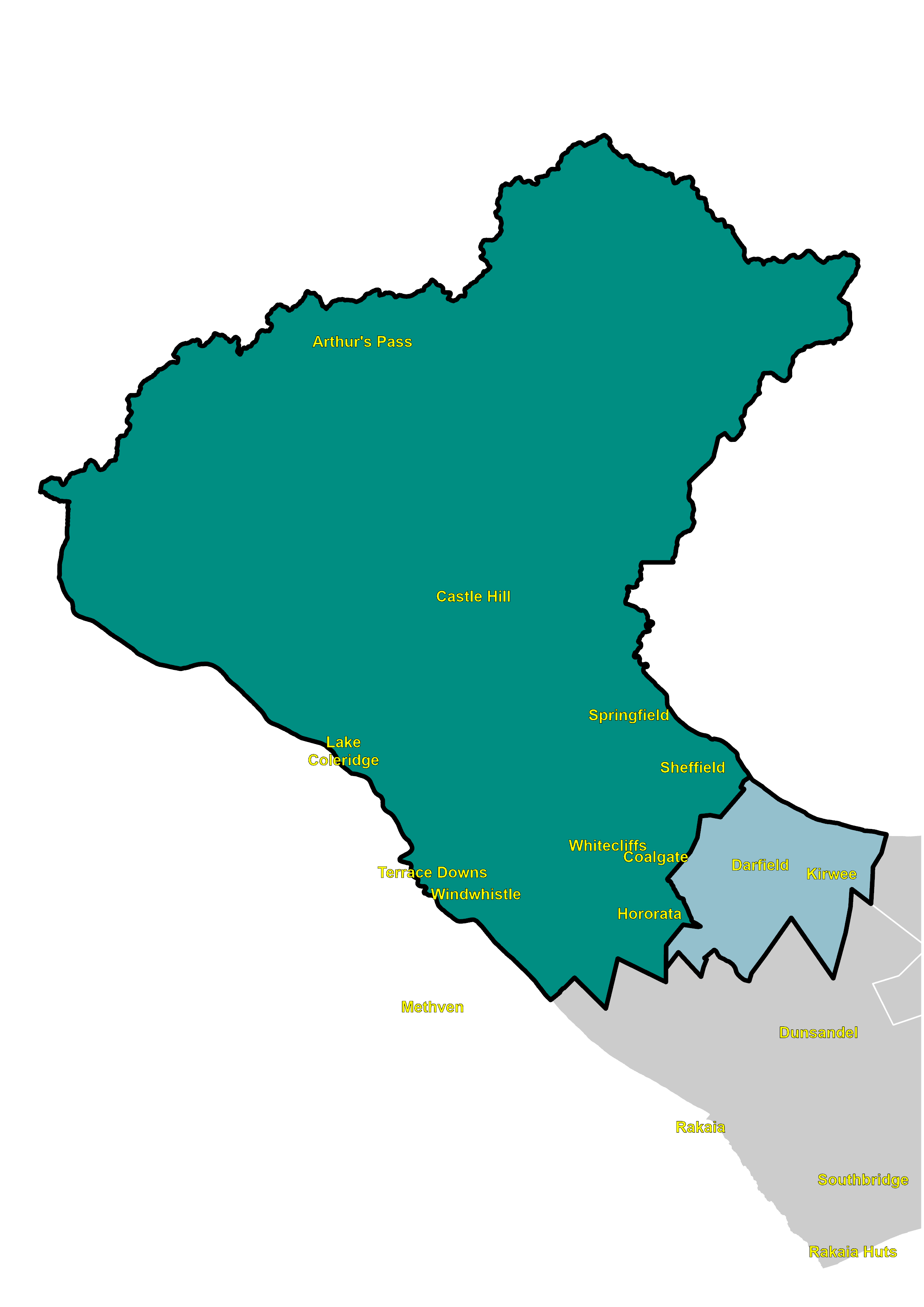
View the maps - Wards with Townships and Malvern Boards with Townships
Final proposal November 2024
Having considered all the objections, the Council resolved to adopt a separate proposal as the Council’s final proposal. The changes made are as below:
- Maintain the status quo with the current ward boundaries and maintain four wards.
- Increase the number of elected members from 10 to 11.
- Maintain the Malvern Community Board.
- Adopt dual names for the four wards - Kā Mānia Rolleston, Kā Puna Springs, Tawera Malvern, and Te Waihora Ellesmere.
The Council considers these changes for the following reasons:
- It addresses the population growth across the district and maintains the +/- 10% rule.
- It responds to feedback from the community within consultation requesting greater representation to reflect the region’s growth.
- It ensures rural representation for our Malvern communities and recognises the large geographic area within this ward through maintaining the community board.
View the Public Notice notifying the final proposal for representation arrangements.
Updated as at 5pm, 20 November 2024.
Initial proposal July 2024
The Council adopted its initial proposal for public consultation on 24 July 2024. Under this proposal, the existing ward structure was largely retained, with the major changes proposed from the current electoral arrangements being:
- Reduce the number of councillors from 10 to eight
- Maintain our four wards with some boundary changes and rename the wards
- No community boards.
Public consultation on the initial proposal was undertaken from 8 August to 12 September 2024.
Read the Consultation Document on the initial proposal.
View the Public Notice notifying the initial proposal.
View the maps showing the proposed ward and subdivision boundaries.
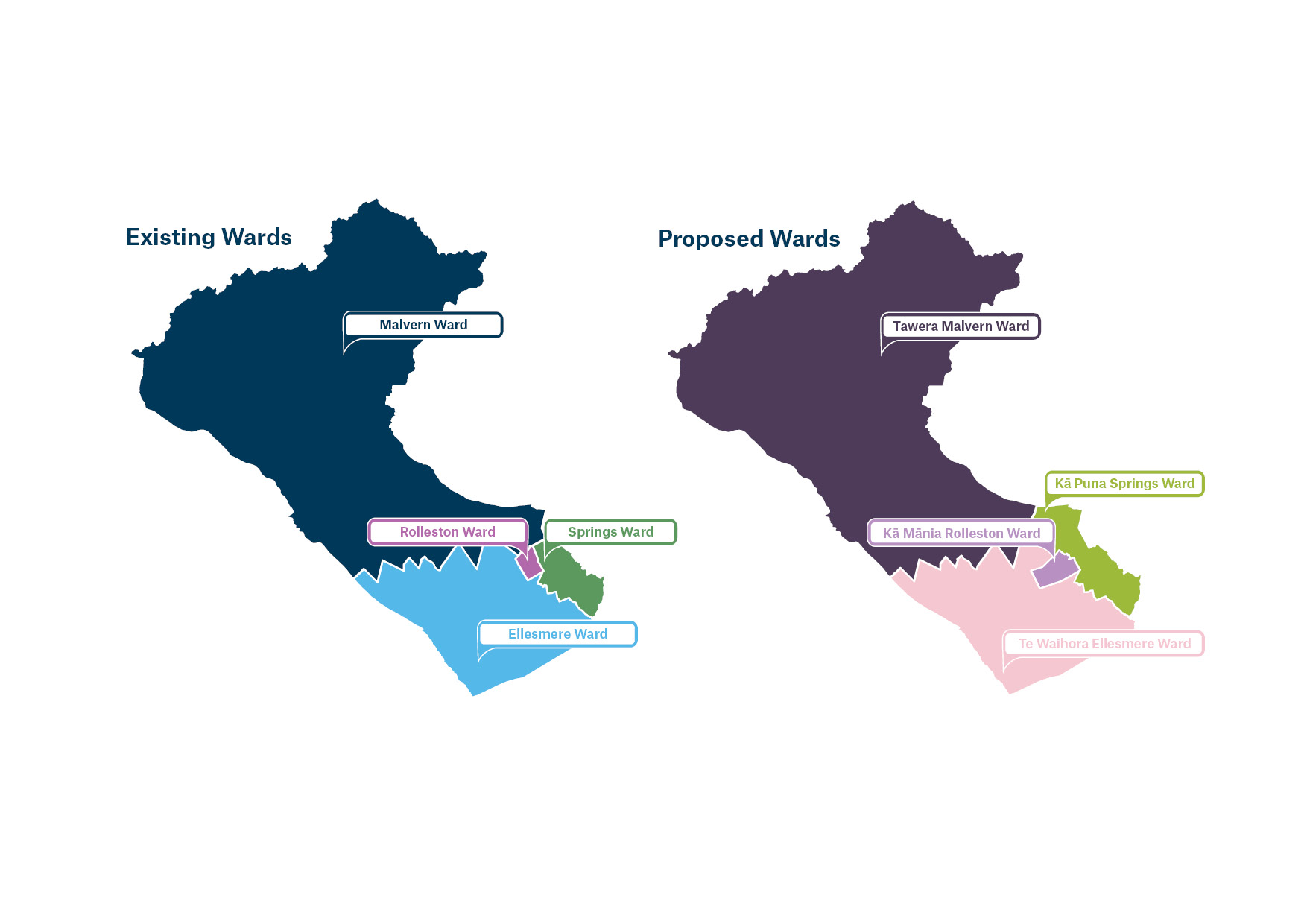
Read the Council report adopting the initial proposal for consultation.
Hearings will be held on Thursday 26 and Friday 27 September with Council deliberations to follow in October.
Submissions received
We accepted submissions on our Representation Review between 8 August to 12 September. Submissions have now closed. The submissions received are available to read below.
- Submissions 1 - 100
- Submissions 101 - 200
- Submissions 201 - 300
- Submissions 301 - 400
- Submissions 401 - 500
- Submissions 501 - 555
- Submissions 556 - 605
- Submissions 606 - 615
Read more about Selwyn's current electoral ward maps and boundaries.
Hearings
Hearings from submitters took place on Thursday 26 and Friday 27 September, which you can watch below.
Preliminary consultation April 2024
We began undertaking our representation review in 2023. This work included scenario workshops as well as qualitative and quantitative research to canvass our community's views. Using this feedback and information, we then carried out a preliminary consultation on possible representation options in April 2024.
During the preliminary consultation, we presented two main options:
- Option 1: Four wards with eight councillors, and no community boards
- Option 2: Three wards with 10 councillors, and no community boards
We also asked people to suggest new names for the wards.
Around 1,200 people visited our consultation page and we received 229 submissions. More submitters preferred option 1 to option 2. In addition to the 229 submissions, we also received 219 responses that were collected by the Darfield Residents Association/Malvern Community Board.
Pre-consultation engagement
In September 2023, the Subcommittee commissioned research to canvass the views of Selwyn residents relating to “communities of interest”. This involved a two-stage process of qualitative, in-depth, in-person interviews, followed by telephone and online surveys of residents.
Research was undertaken in November 2023 and the key findings are as follows:
- Residents identify more with the township they live in than the ward.
- Many residents were unsure which ward they belonged to.
- 35% of the district depends on Rolleston for their daily needs.
- A common sentiment among residents (outside of Rolleston) is that the Council’s attention is disproportionately focused on Rolleston, leading to perceived neglect in other areas.
- There is a notable appetite for revising the representation framework to represent the changing needs of the community better.
- Many of the Selwyn District’s population engage in work, play, and access services within their local communities.
- Over 70% of residents are not content with either the ward structure or the number of councillors
These findings provided a useful framework for the Subcommittee when assessing options and scenarios for the initial proposal.