About the plan change process
About making a change to the district plan
A change to a district plan is a public process which requires research, evaluation and consultation. A plan change can be initiated by us, the Council, or by members of the public (private plan change).
Examples of possible plan changes include:
- rezoning of land
- addition of a building to the schedule of heritage buildings
- amendments to rules
- implementing Government directions
Information to be submitted with a private plan change request
When submitting a private plan change request, certain information must be provided with the request. The exact requirements are outlined in Clause 22 of the First Schedule to the Resource Management Act 1991.
You can also find a summary of what information is required in Appendix 1 of the Partially Operative Selwyn District Plan 2020.
When preparing the required information. the Council encourages applicants to also engage with mana whenua through Mahaanui Kurataiao Limited.
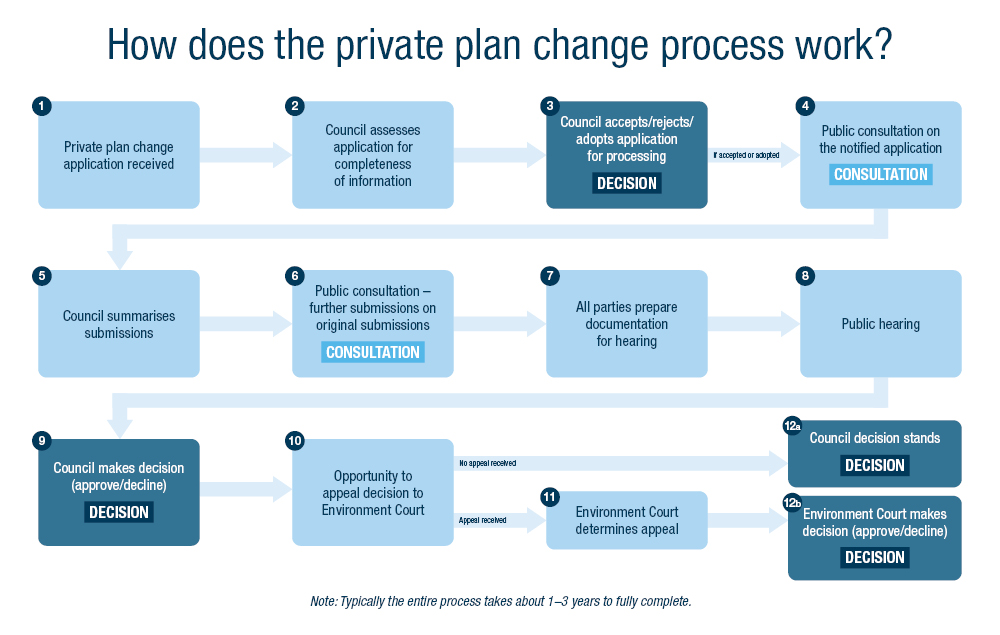
The Resource Management Act and relevant government policies underneath it, such as the National Policy Statement on Urban Development 2020 (NPS-UD) outline the private plan change process that we are required to follow:
Step 1-2: A private plan change request needs to be reviewed by staff before it goes to the Council for decision whether they should be processed.
Step 3: Once processed the plan change request goes to the Council for decision on whether to adopt, accept, or reject the request for processing, or convert the request to a resource consent.
Step 4: All requests that are accepted or adopted as a proposed plan change are then notified for public consultation.
The Council publicly notifies the proposed plan change request by putting a notice in the newspaper, on the Council website, and/or by sending directly affected parties information in the mail. Members of the public are then able to make a written submission to the Council supporting or opposing the proposed plan change.
Step 5-6: The Council prepares a summary of all submissions received and makes them publicly available on the Council website. Members of the public can then make further submissions that either support or oppose an original submission.
Step 7-8: If any submitter asks to be heard in support of their written submission, the Council holds a hearing to consider the submissions and hear any evidence that supports them.
Step 9: The Council then makes a decision on submissions and evidence presented at the hearing, informs the submitters of the outcome in a letter and in a public notice in the newspaper.
Step 10: Appeals to the decision can be lodged with the Environment Court within 30 working days of the Council making the decision. See Ministry of Environment’s You and the Environment Court guide for more information on the Environment Court process.
Step 11-12: The proposed plan change becomes fully operative after the Council has made its decision and all appeals, if there are any, have been resolved.
Note: We are required to make a decision on a private plan change requests within two years of the notification (from step 4 to step 9).
Frequently asked questions on plan change requests:
Why is the Council processing all the current private plan change requests?
Why does the Council appoint independent commissioners to consider plan change requests?
For all plan change requests the Council has delegated the authority to independent commissioners to:
- hear directly and in person the submitters,
- review and consider all of the evidence produced, and
- make a recommendation to the Council.
Independent commissioners have the expertise to hear and consider the submissions, especially given this is a highly complex process.
What information do commissioners consider when reviewing a plan change request?
Submissions received during public consultations, provided evidence and all legislative requirements.
Who makes the final decision on whether or not to approve a plan change request?
The Commissioner, who has seen all the evidence and submissions, makes a recommendation to the Council. But only the Council can make the final decision as under the RMA the Council cannot delegate to a commissioner the power to approve or reject a plan change request.
Can the Council reject a commissioner’s recommendation?
In theory it can but this is not an accepted good practice. This is because the Council hasn’t been involved in the hearings, hasn’t considered the evidence and hasn’t reviewed submissions.
Also going against the recommendation would likely expose the Council to a legal challenge by applicants.
More information on how RMA works
Ministry for the Environment has developed a series of guides to help people understand RMA processes and how to work with councils. Check their first guide Understanding the RMA and how to get involved.
For all guides visit Ministry for the Environment website.
Contact us
If you would like to request a private plan change to the district plan, contact us on 0800 SELWYN (735 996) and request to speak with the duty planner, or email us at contactus@selwyn.govt.nz